Saturday, January 28, 2012

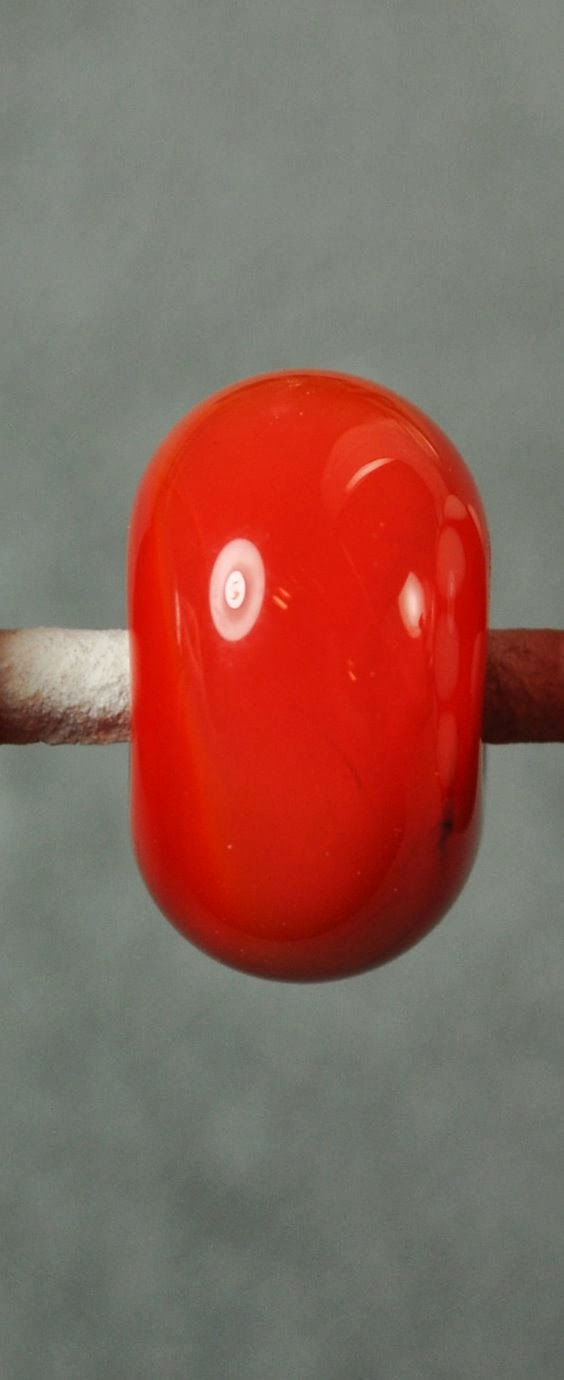
CiM 103 Crimson

Here is the other of the two new transparent reds - Ruby Slippers and Crimson -  from CiM - and, as I said before -  I struggled with these.

Note: Transparent reds are striking colours - they lose their colour when heated to molten - and then you let them cool, and re-introduce them to the flame, and the "strike" - regaining their red colour. Generally - I have no problems with the transparent reds.

I started with the same difficulty with Crimson as I did with Ruby Slippers. Again, I don't know if it was me or the glass. Other testers did say it took a while too.

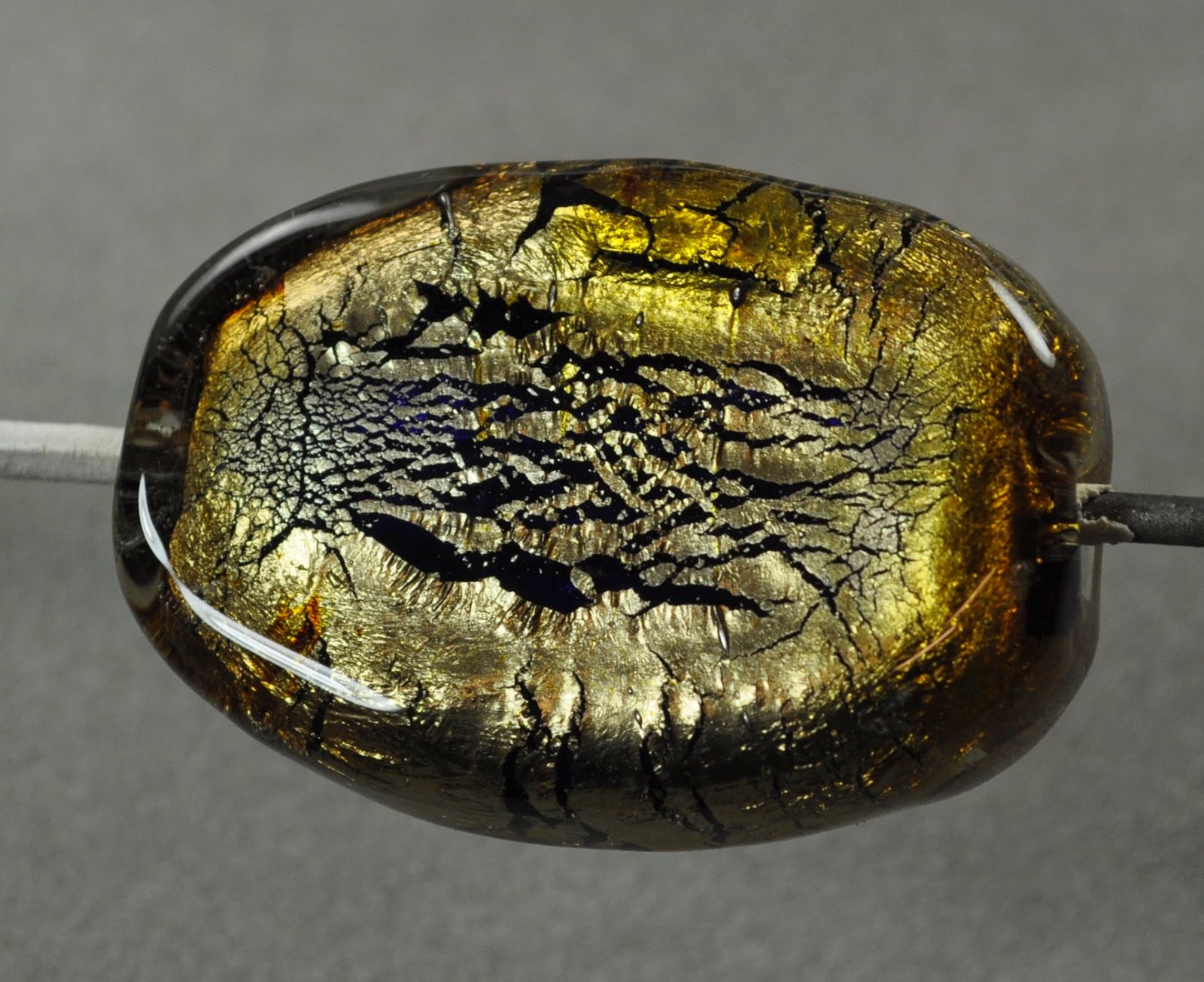
The one on the left (yellow) - I heated to clear and kilned it that way - so all that yellow colour developed in the kiln. The one on the right, it turned cloudy - and you can see that it has a lot of brown in the haze.

I did eventually get this one to strike - a rather nice, bright shade of red. Unfortunately - I spent so much time cooling it and re-heating it a little that it cracked when it came out of the kiln.

'This one was a base of Crimson, encased. It struck almost immediately when I encased it, But it also went hazy too. And while it is a prettier colour in real life - it also cracked.
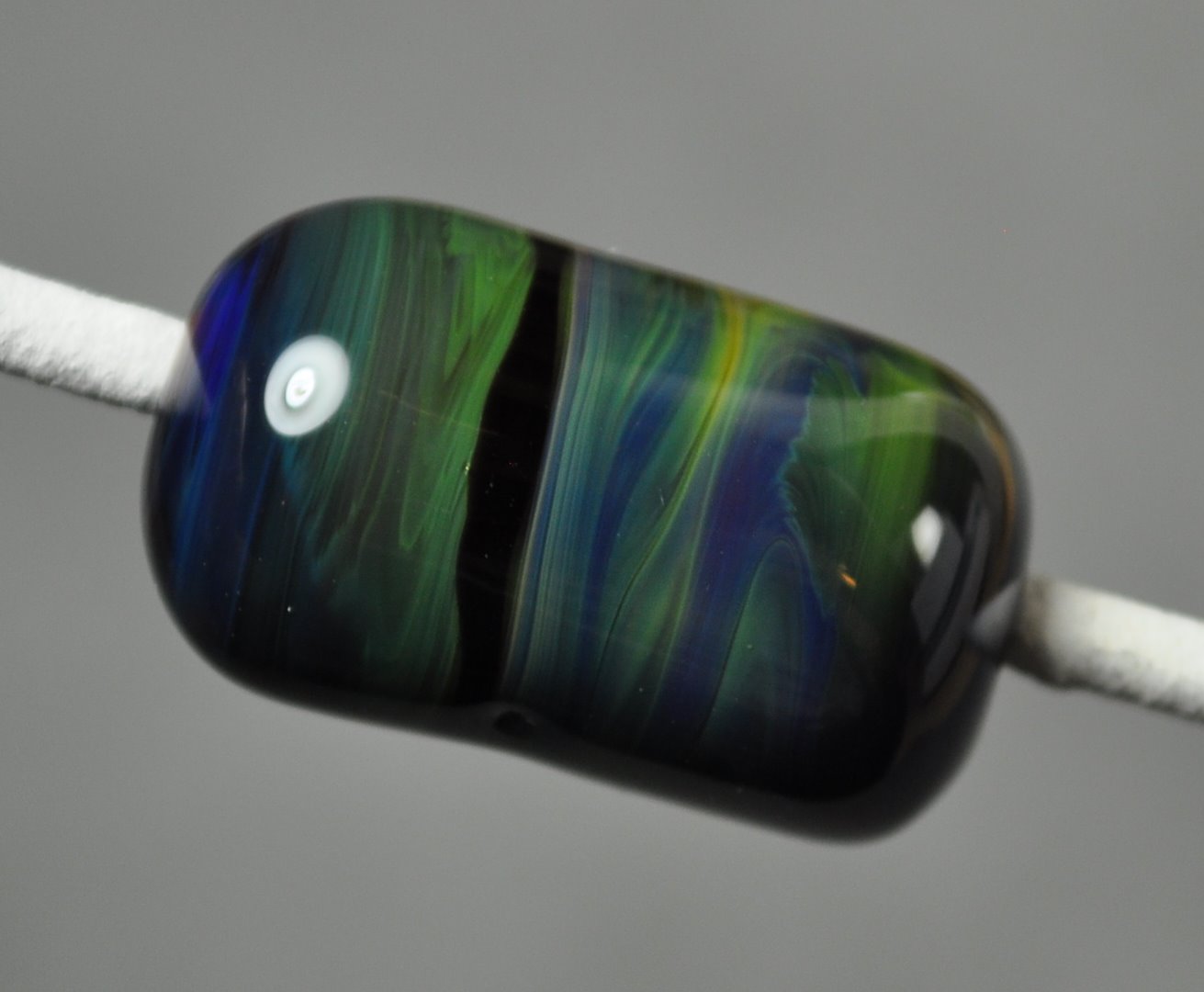
This one struck when I marvered it - but it is so dark - it is hard to tell that it is red. However, with the trails of Triton - it is a rather handsome bead!

Gobs of potential in this colour - but I had difficulty with it. Your milage may vary.

Thursday, January 26, 2012

CiM 104 Ruby Slippers

Two more transparent reds - Ruby Slippers and Crimson -  from CiM - and I struggled with these. I don't know what it was - but I could NOT get Ruby Slippers to strike.

Transparent reds are striking colours - they lose their colour when heated to molten - and then you let them cool, and re-introduce them to the flame, and the "strike" - regaining their red colour. Generally - I have no problems with the transparent reds.

But not these two. I had the same problem with both Ruby Slippers and Crimson. I don't know if it was me or the glass. I did try both of them on the same day - for what ever that is worth.

Other testers for Ruby Slippers report results from difficulty striking to a "glorious, garnet red."

From the left, we have Ruby Slippers on white, on clear, and two self coloured beads. The end one (yellow) - was clear when it went into the kiln. Maybe they needed to kiln strike. 


Again - Ruby Slippers, and I was definitely having trouble striking it. It was also hazing up on me. The haze has come out sort of a muddy colour.

Although - if you wanted to do something with a variegated yellow and orange - this might be just exactly what you are looking for.

Tuesday, January 24, 2012

Wave bead

Random eye candy - here's one of my signature "wave" beads - done in "Earth" and Eff. Med Lapis. It is done on the Sirius system mandrel and insert.

It doesn't showcase the "Earth" well - but it's bluuuue. How bad can it be?  ;-)


Sunday, January 22, 2012

CiM 102: Valentine Revisited

I wanted to revisit CiM Valentine - as I had this nagging sense that I just hadn't done it justice.

After all - I really like it - and I was wondering why the photos seemed so dark and dreary.

So I remade the beads - and here you see, from the left, two self coloured beads, one encased in clear, and one with white dots with Valentine on top.

Boy - those are not what you would call red.


I tried them under various lights around my studio - and finally  - I took them outside to shoot - which I almost never do.

et Voila! Despite superiour lighting technology - this colour pops in overcast and bright sunlight - revealing it's true redness.

BTW - the encased one - while looking lighter than the un-encased red - has not cracked. (Opaque reds frequently are fussy about being encased.) It's not a real deep encasing - but there it is.

So there you go - shoot your Valentine in the sun.

Make what you will of the symbolism in that!  ;-)

Thursday, January 19, 2012

Gas Terminology Translation

Around the world - different terms get used for the gas we use to run our torches - so here's a little clarification as I understand it - mostly for my European readers - who are often baffled by our terminology.

In North American (Canada and the US) - we mostly run our torches on Propane or Natural Gas.

For those in Europe who are wondering what the heck natural gas is: Natural Gas is a piped gas - part of the utilities (like water and electricity) - and not necessarily available outside of  major urban centres. It is about 90% methane.

Butane is what we fuel cigarette lighters with. Also - some of the small torches for brazing and soldering run on butane.

Propane is sold in tanks, or delivered to large tanks for those using it - mostly in more rural areas - for home heating, cooking or industrial applications.

Propane is stored as a liquid in the tank, and what you are burning is the vapor as the gas evaporates. (But is sold in pounds - i.e. a 20 lb tank.)

Propane burns at about 50 degrees F hotter than natural gas - which doesn't sound like much.

But - my experience is - you can melt the glass a lot faster with propane than natural gas. The propane makes, for want of better terminology, a "denser" flame - it seems to transfer the heat more efficiently. The difference, all else being equal - is quite dramatic.

I also have experienced far less problems in "scorching" or "burning" the glass when working low in the flame with propane than natural gas. I can work far closer to the torch face with propane than with natural gas. If I get down close to the candles (those blue fingery parts of the flame coming directly off the torch face) - with natural gas, I'm more inclined to get grey smokey effects in the glass.

I have certainly heard some lampworkers comment about being careful of propane because of built up of contaminents in the tanks and hose - and it may have been in the past that the quality control for propane was not as good - but I have never had a problem personally.

Propane is scented to make it easy to find leaks - the resulting scent is very distinctive - I find it nauseating - but you should never smell it - the burn from the torches is very clean.

One other thing to remember - propane is heavier than air, so if it spills, it will sink to the ground. When you plan your studio space - think about this. So, if you are setting up in a basement - look for floor drains. Leaked gas could conceivably "fall" to the floor, flow into the drain and accumulate. If there is an electric sump pump in the drain to keep the water levels down, when it starts - electric motors can spark and "whomp" - potential for explosion. (Natural Gas is neutral - it just mixes.)

Likewise - look around for gas-fueled furnaces, water heaters, with a pilot light.

Some of the smaller, portable torches like the Hot  Head and the Fireworks will run on a MAPP gas canister - for as long as those continue to be available. (They are being phased out here).  MAPP gas is a propane blend - it has added ingredients to make it burn hotter. Mostly it gets sold in small containers for light welding and soldering and hooking up to portable equipment, like camping stoves. (They will also run on propane.)

I don't pretend to be an expert on this - just throwing some info out there for you to think about. If you want an expert - read Vic Henley's articles in the glass community magazines.

Oh, which do I prefer? Propane - I would rather melt with propane - but natural gas has the advantage of being delivered in a pipe directly to your studio and you never run out.

Well - that turned into a sort of brain dump - hope someone finds it helpful though. ;-)

PS - if you have some info about the gas used in your country - leave a comment!

Glow Frit

I did some experimenting with a stash of glow frit that I recently came across.

The instructions said to make stringer from the frit, so I did that.

To do this, (make stringer from frit, that is) - start with a rod of clear glass and a heat the end of the clear until you have softened the end, then use it to pick up a chunk of frit on the end rod. Bring that back to the flame and heat it to soften it, and then pick up another chunk of frit and melt it in Keep repeating this, until you have a nice sized gather - big enough to pull into a stringer. Repeat as necessary for more stringers as required.

For this first bead, I started with a clear core, then added the glow frit-stringer, and then encased with CiM Caribbean, and then shaped into a cube.

You can see I burned something - not sure if it was the clear or the frit or the Caribbean - but ick. 


 However, this is it glowing! Nice glow, eh? Really quite dramatic.


Next - I tried a marble. This time, instead of the stringer, I just got a big ball of clear hot, and jammed it down into the frit and picked up a big chunk, and then just worked around it, encasing it, adding dichro, etc.

I trapped a lot of air in there, inadvertently, by doing it that way - but I did get a nice, substantial chunk of frit.


Resulting in this marble - when you turn out the lights! The frit was labelled blue - hence the blue glow.


The glow effect is quite strong, and yes - like every other glow-in-the-dark thing that is not actively radio-active - you have to "charge" it up under a strong light.

But I tell you - two of us in the bathroom - with the lights out - (at the studio)  - squealing like schoolgirls  - totally made one customer's day. ;-)

Tuesday, January 17, 2012

Gas Consumption - Nortel Torches

Currently in the process of re-design the studio for beadFX - where I teach - as they are moving to a new location - which is one of the reasons I've been very quiet lately. (The other has to do with my mother being ill - but that's another story.)

So - trying to figure out how big a gas line we need. We're going with Natural Gas (again) - and I got the following figures from Peter at Nortel Mfg  - so I thought I would publish them here - in case someone else needs them, or I need them at some point in the future.

For Natural Gas
Mega & Minor Torch - at 1/4 psi, uses 3 litres per minute

Midrange Torch - at 1/4 psi, uses 8 litres per minute

Usage increases with psi increase - possibly up to 50% more.

BTUs - calculate at 35 btus/litre.

This is the info I fed to the gasfitter - got it straight from Peter.

Just don't ask me to explain it! ;-)

Wednesday, January 04, 2012

CiM 203 Pimento Ltd Run

Pimento - from Creation is Messy - a vibrant, eye-popping orange.

This is a happy, happy colour. - bright and cheery and in-your-face saturated!

This is also a really soft opaque - this melted very fast.


 Here are two self-coloured spacers.

This one had dots of a light turquoise (CiM Fremen) - you can see there has been a reaction and there is a handsome dark grey line around the Fremen. 
 This is encased in clear - and is slightly lighter in real life than the un-encased versions - although it is tough to see that here. By the way - that is pretty normal for encased opaque oranges and reds - to show lighter.

And with ivory dots. A real creamsicle colour combo. Hmmm - ivory core beads with an encased of Pimento, (with the core showing at the sides - like a white heart bead) - nummy.

A really cheerful colour. Love this one.

Monday, January 02, 2012

Monday, December 26, 2011

CiM Purple Haze

CiM Purple Haze - over silver foil. Now THIS shines!

This was a core of something dark - I thought it was black but I see a little blue - so I think it might be indigo or one of the dark colours that I have tested recently.

A layer of silver foil, and then encased. This is photo'd in cool light. You can see where the Purple Haze has reacted with the silver to turn golden, in some places more than others.The overall effect is a antiquey gold on gold look.

Here it is again,in warm light - the golden effect is still there, but now it is more of a pink and gold.

Purple Haze over Silver Foil - WIN!

Saturday, December 24, 2011

TAG Tibet - Opaque vs Clear

Tibet, from Trautman Art Glass - is "a transparent version of Dalai Lama"  - according to their website. So imagine my surprise when the latest batch that I picked up was opaque in the unworked rod.

The opaque variation is significantly easier to strike!

Here we have, the Tibet (Opaque) on the left of the black line, with significantly more colours - and Tibet (Clear rod) on the right.

Same bead, different side.
All of these are the Tibet-clear rod, and encased. The two on the left just would not strike. The two on the right struck - but I'm not that enamored of the colour.
These four are the Tibet-opaque - you can see that I had a lot more success with these! These are also all encased.

Here we have, three on the right that are the Tibet - opaque, and the two on the left, were a mix of the clear and opaque. All are encased.


I'm gonna scoop up all of this batch I can get my hands on - it is waaaay nicer to work.


Thursday, December 22, 2011

TAG Dalai Lama vs Dalai Lotus

In my latest bundle of TAG glass - something labeled Dalai Lotus.

Here is the same bead - showing all sides. The Dalai Lama is on the left, the Dalai Lotus on the right. They seem fairly similar, except their seems to be some purples and reds in the D. Lotus on one side. Given the vast range of colours in these glasses - it's fair to say that one bead does not a test make. ;-)


Either glass sure is impressive though!

BTW - that is a band of black separating the two colours - simply for reference purposes.

These are all Dalai Lotus, encased.  


And this is the Dalai Lama - encased.

Ain't this a beauty? It started as three beads side by side (Tibet - clear) - which got away from me, so I filled in with Dalai Lama, added a few trails of Triton, and encased it and marvered it.

 Here you can see what was where.

This was similar - but mashed. Never got this one to strike to my satisfaction, however. 


Some days - the glass just sings for you. On those days - just work until you drop. ;-)


Tuesday, December 20, 2011

CiM 602 Purple Haze Ltd Run

CiM calls Purple Haze "a transparent that shifts between blue and lavendar, depending on the lighting." Effetre makes a colour like that - but it is totally unlike this colour.


In the world of commercially made beads - fire-polish, pressed glass, and crystal, this colour is generally called "Alexandrite." 


It can look like this. (Photo copyright beadFX Inc - all rights reserved, used with permission).


However, for me, the Purple Haze does not show blue in fluorescent light, but rather a light grey.   I dunno - mebbe I smoked it. (Maybe they will look better off the mandrel and cleaned?)
 Here it is in warm light - it is a much redder purple than the Effetre 080 and 081 - Light and Dark Lavender.
 Here is the Purple Haze - shown with a bracelet made up of a mix of glasses, but with quite a bit of the Effetre Lavendar (Colour shifting).
 Here it is again in fluorescent light. The red arrows note the same bead, you can see that the change is quite dramatic.
Anyway, the cool light/blue phase of this glass - doesn't look light blue to me. The warm light - reddish purple pink colour is pretty enough though.

Sunday, December 18, 2011

CiM 102 Valentine

Here's another of the new reds from CiM. CiM calls Valentine "a saturated and bright opaque red."

It is a bright red  in very strong light. It has a tendency to look dull though, if the light isn't strong enough, and it is difficult to photograph accurately.

See - here we have two self-coloured beads. In real-life, you can practically smell the cherry-pie filling - but here - they look dark and gloomy.

This is a very thin layer over clear - and it reads as a transparent.
And Valentine as dots on white - notice that it looks like a super-dense transparent here.
Here - I tried photographing it in different lighting conditions. This isn't too bad.
This is right up close under the incandescent desk light.
And this one I colour corrected manually - it looks reasonably right on my monitor - your mileage may vary.

It is easy to strike. Like I said - it is a nice colour in person - cherry pie filling red - but hard to shoot - so if you do a lot of etsy or ebaying - be prepared to tear your hair out!